
The Crisis of Democracy in South America: Authoritarian Tendencies and the Struggle for Political Stability
- 1 oct 2025
- 3 min de lectura
By Brissa Nuñez
In recent years, democracy in South America has entered one of its most critical phases since the wave of democratic consolidation in the late 20th century. Across the region, leaders are testing the limits of constitutional authority, and citizens are losing faith in the promise of democratic governance. Authoritarian tendencies, weakened institutions, and deep social divisions have made it easier for democracy to weaken. From the collapse of institutions in Venezuela, the “security-first” experiment in El Salvador, and the endless political instability in Peru, South America today has become the stage for a profound struggle between keeping democracy and sliding into authoritarian rule.
Below is information on some of the region’s most emblematic cases:
Venezuela: collapse of institutions
Venezuela was once considered one of the most stable and prosperous democracies in South America, supported by oil wealth and a tradition of electoral politics. But in the past two decades, the country has become the clearest reminder that democratic decline often begins internally. Beginning with Hugo Chávez in the late 1990s and continuing under Nicolás Maduro, the country experienced a systematic dismantling of institutional checks and balances. The judiciary and electoral bodies were brought under government control, and voices from opposition leaders to independent media were silenced through intimidation and imprisonment. Today, Venezuela faces severe humanitarian, economic, and migratory crises. Millions have fled the country, and international organizations widely denounce the government as authoritarian. This case shows how the weakening of institutions can lead a country into long-term authoritarian rule.

El Salvador: Security vs. Democracy
El Salvador is a Central American case with implications for the whole continent. In recent years, President Nayib Bukele has gained enormous popularity, largely because of his hardline strategy against gangs. By building massive prisons, his government has managed to bring down crime rates to levels the country had not seen in decades. For many Salvadorans, who had lived for years under the fear of violence and extortion, this shift has felt like a relief. However, the methods used to achieve these results raise serious concerns about the future of democracy in the country. Bukele’s approach relies on mass arrests, often without due process, along with limits on freedom and restrictions on civil liberties and human rights organizations have documented cases of arbitrary imprisonment and abuse. At the same time, Bukele has pushed through reforms that expand his control over other branches of government, making it easier for him to stay in power. El Salvador's case demonstrates that democracy becomes fragile when citizens, desperate for security, are willing to trade away rights and freedoms in exchange for safety.

Peru: Endless Political Instability
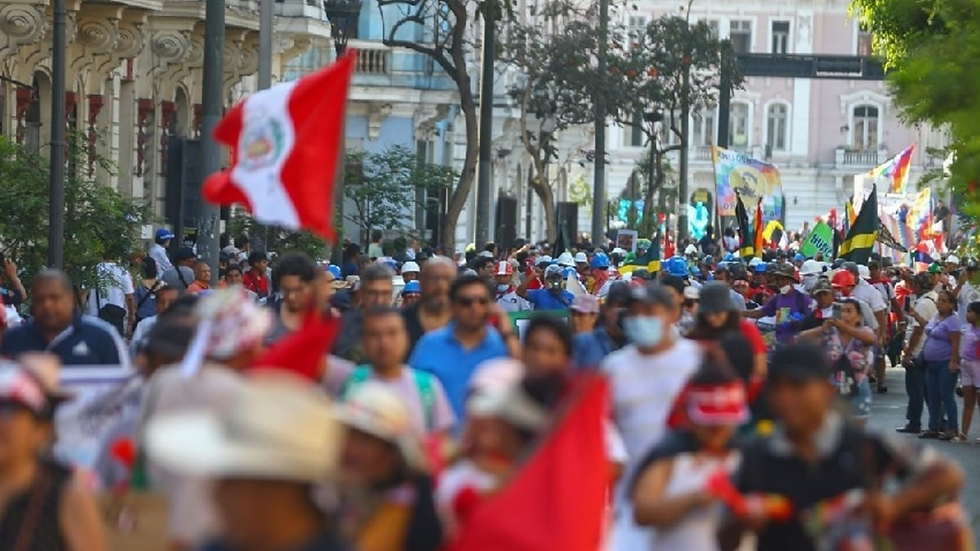
Peru represents a different form of democratic crisis, one marked not so much by authoritarian control but by constant political instability. Instead of one leader concentrating 2 power, the country has faced repeated problems between presidents and Congress, leading to a cycle of resignations and corruption scandals. In just a few years, Peru has gone through several presidents, with none able to stay in office long enough to bring real stability or carry out long-term reforms. Peru lives in a state of permanent turbulence: democracy exists on paper, but in practice, it struggles to deliver the stability and governance that citizens expect. Peru teaches that democracy is not only about holding elections, but also about building stable institutions capable of earning citizens’ trust.
Lessons from South America’s Crises
These cases reveal different faces of South America’s democratic crisis. Venezuela shows institutional collapse, El Salvador embodies the trade between security and freedom, and Peru exposes the dangers of instability. The challenge for the region is to defend democratic principles while addressing citizens’ demands for security, equality, and justice. Civil society, independent institutions, and regional cooperation remain crucial.
References:
Brookings Institution. (2023). The rapidly deteriorating quality of democracy in Latin America. Brookings. https://www.brookings.edu/articles/the-rapidly-deteriorating-quality-of-democracy-in-latin-america/
International Institute for Democracy and Electoral Assistance. (2023). The global state of democracy 2023: The state of democracy in the Americas. https://www.idea.int/gsod/2023/chapters/americas
Levitsky, S. (2018). Peru: The institutionalization of democracy without parties. In S. Levitsky & J. Loxton (Eds.), Challenges of party-building in Latin America (pp. 326–356). Cambridge University Press.
Roberts, K. (2020). The fall of democracy and the rise of authoritarianism in Venezuela. University of California, eScholarship. https://escholarship.org/uc/item/5mj6j3t8
Scribner, D. (2022). Latin America erupts: Millennial authoritarianism in El Salvador. Journal of Democracy, 33(4), 54–67. https://doi.org/10.1353/jod.2022.0047


Comentarios